straddly
Dead hang workout: stop testing, start adding seconds
Build a dead hang workout around repeatable sets, not daily records. Use a 20-second example, a four-week table and clear rules for adding time.
By The Straddly team · · 7 min read
Your best dead hang is 20 seconds. So why does the next attempt fall apart at 11?
For a beginner dead hang workout, start with two sessions a week and three holds you can repeat cleanly, resting 90 seconds between them. If your controlled best is 20 seconds, try 12 seconds per set rather than chasing another maximum.
That is a starting experiment, not a scientifically validated dose. The useful part is the rule that follows: add time only after all three sets are repeatable across two sessions. Your best attempt tells you what happened once. Training needs a number you can use again.
First, make the seconds comparable
A thick painted park bar and a smooth gym bar are different tests. So are a fresh hang and one done after five sets of pull-ups. If you change the conditions every time, the stopwatch gets very precise about the wrong thing.
Choose one bar and an overhand grip around shoulder width, with your thumbs wrapped around it. Use the same chalk policy each time. Note whether your feet are supported and whether the hang comes before or after your pulling work.
For the example below, the hangs are short, separate sessions, after warming up and before any tiring grip work. If you put them after pull-ups instead, establish your starting duration there. Do not compare that result directly with a fresh test.
Bodyweight is worth noting when it changes noticeably. Holding 85 kg for 20 seconds and holding 70 kg for 20 seconds are not identical tasks. Neither number tells you where you rank against everyone your age.
Get into a hang you can control
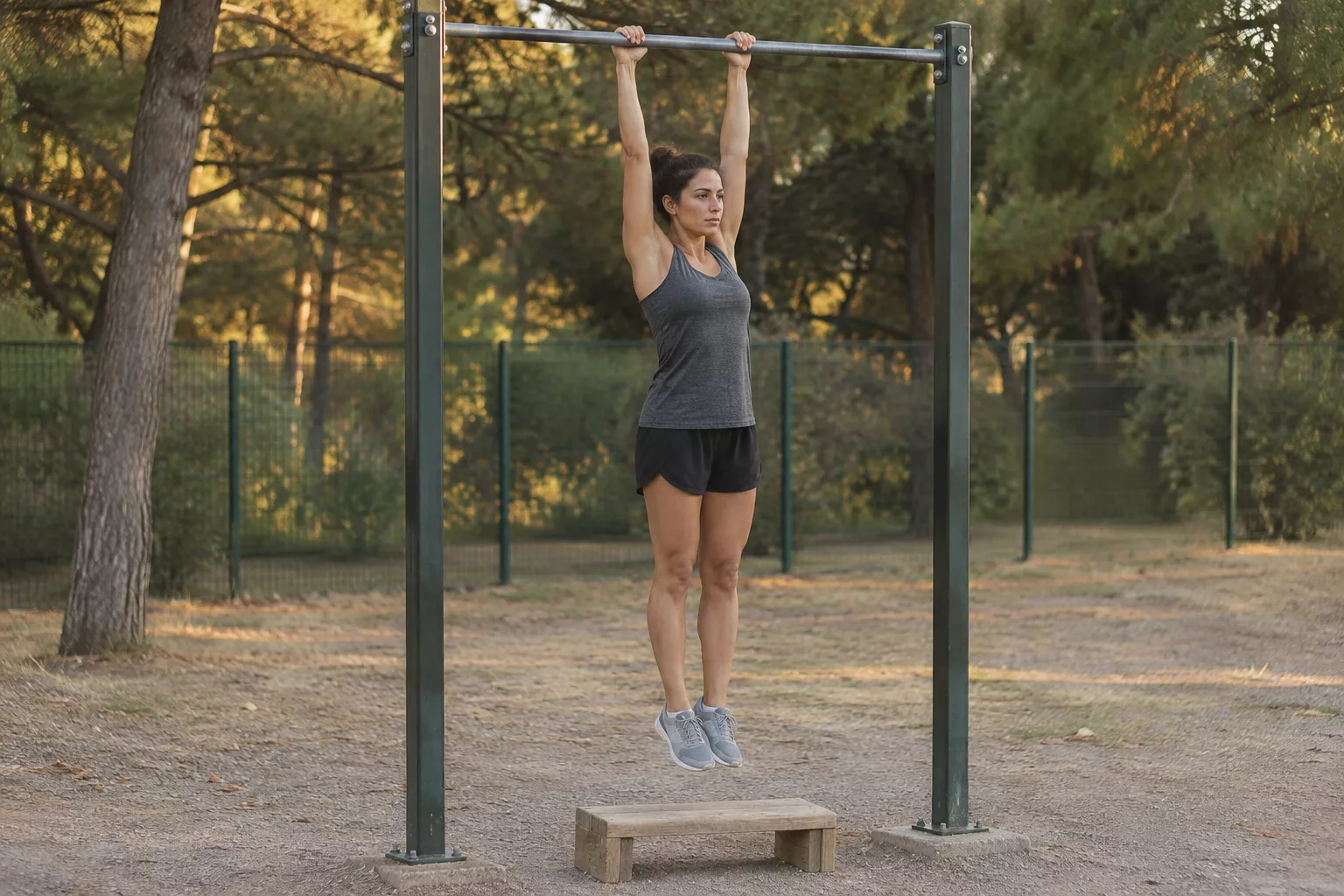
Use a stable step to reach a securely installed bar. Transfer your weight gradually, straighten your elbows and let your feet clear the support. Keep your body quiet and breathe. Finish while you can still place your feet back on the step rather than waiting for your fingers to peel off.
A passive hang lets the shoulders rise naturally. An active hang adds muscular control around the shoulder blades and raises the body slightly without bending the elbows. Pick one version for this training block and label it. Switching halfway through a timed set makes the comparison muddy.
The dead hang exercise guide shows the setup and tracking method. The demonstration uses some shoulder engagement; it is a visual reference, not a demand to force your shoulders down as far as possible.
 Animated demonstration of a straight-arm hang from a bar
If you cannot stay controlled for five seconds, keep your feet on the step and unload enough weight to practise a steady hold. Record that assistance. An assisted 12-second set is useful work, but it is not the same result as 12 seconds unsupported.
Stop if you feel pain, tingling or numbness, and ask a physiotherapist or doctor about those symptoms. A timer is not a reason to hang through them.
Turn a 20-second best into a training dose
Warm up with a few minutes of easy movement, then two brief foot-supported hangs. After 90 seconds of rest, do one controlled unsupported hold, stopping before you lose your grip or position. For this worked example, suppose that gives you 20 seconds.
On the next session, try 3 × 12 seconds, with 90 seconds of rest between sets. Schedule two sessions on nonconsecutive days, such as Monday and Thursday. Keep this separate work small enough that it does not spoil your main training.
Twelve seconds is 60% of that 20-second starting result. The percentage only selects a trial duration. It does not measure how hard every later set feels, and it will not suit every reader. If the third set is already a fight, shorten the target.
Here is what four weeks could look like if every step goes well:
| Week | Each of two sessions | Total hanging time per session | Rest between sets |
|---|---|---|---|
| 1 | 3 × 12 seconds | 36 seconds | 90 seconds |
| 2 | 3 × 14 seconds | 42 seconds | 90 seconds |
| 3 | 3 × 16 seconds | 48 seconds | 90 seconds |
| 4 | 3 × 18 seconds | 54 seconds | 90 seconds |
The weeks are placeholders. If 14 seconds takes three weeks to repeat comfortably, stay there. Nothing has gone wrong because a calendar moved faster than your grip.
Also notice the arithmetic: three 12-second holds give 36 seconds of work, but they do not equal a continuous 36-second hang. Track total work and best continuous hold as separate numbers.
Use one rule to add seconds
Increase the target by two seconds per set only after two sessions in which you finish every planned set with the same setup, a steady position and a controlled exit. You should feel able to keep hanging briefly, without needing to prove exactly how much longer.
Keep rest at 90 seconds while you test this progression. Adding time and cutting rest in the same week hides which change made the session harder.
Suppose the target is 14 seconds and your log reads 14, 14, 10. That session does not qualify for an increase. Next time, repeat 14 seconds if the early stop was an isolated setup problem. If the final set was simply too hard, return to 12 seconds for all three. Rebuild from a dose you can finish.
When several sessions get worse, look at the rest of the week before adding more hangs. Extra climbing or heavier pulling may explain the change. One shorter session can be more useful than another maximum attempt.
Log the setup, not just the record
Your entry might look like this: “Monday, same park bar, overhand, active hang, no chalk, no foot support, before pulling: 12/12/12 seconds, 90-second rests.” It is dull. You will appreciate that dullness when Thursday's result needs interpreting.
In Straddly, you can record hold durations and keep the exercise in a routine. Add the setup details to your notes so that a longer hold reflects the same task. Keep that recurring session beside your other saved routines.
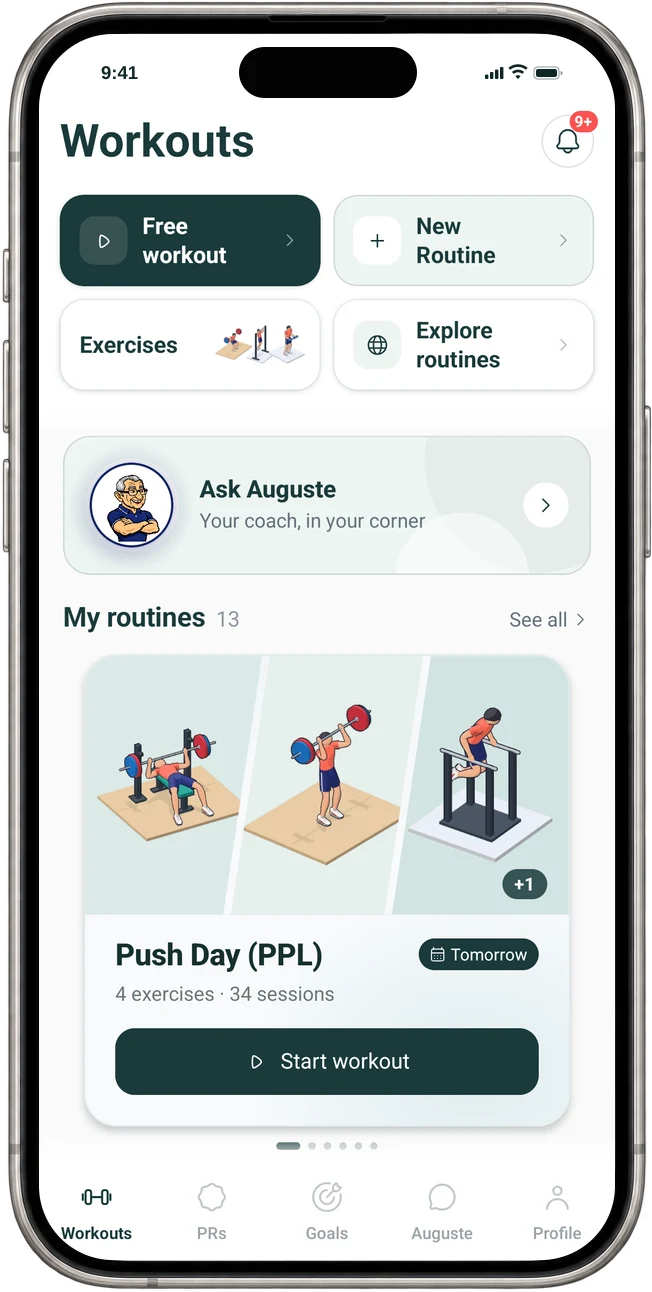 Workout home screen with saved routines and the Ask Auguste entry
A weekly view is useful for a different question: did you actually train often enough to compare sessions? Straddly's profile shows a training heatmap. It cannot tell you whether a hang was technically clean; your set notes still matter.
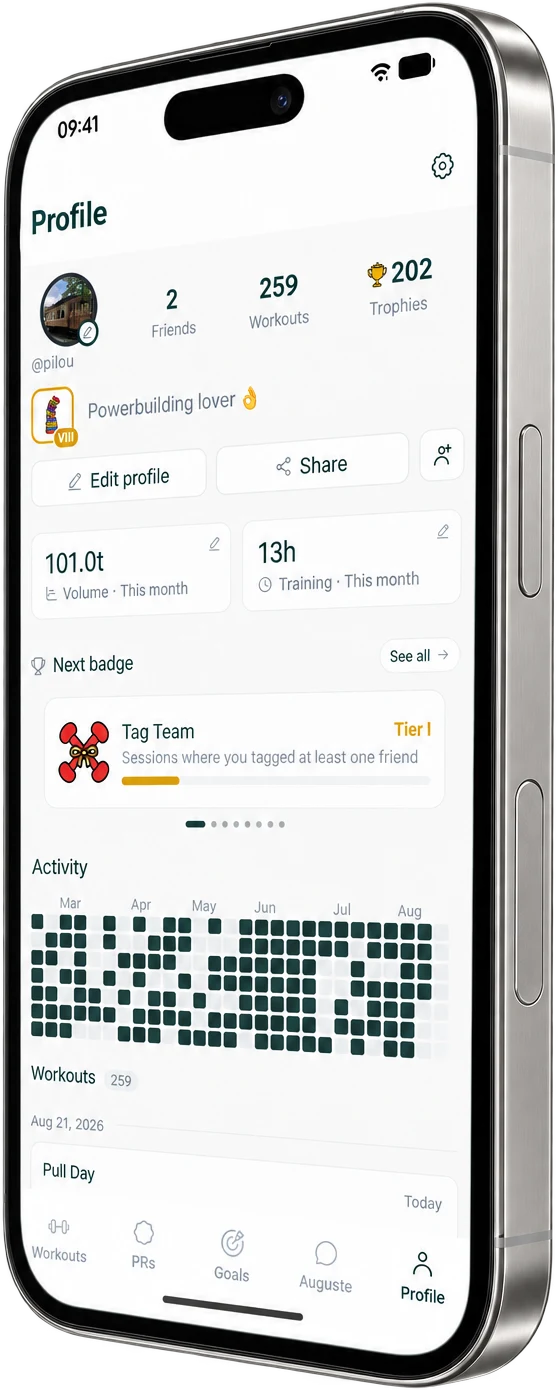 Profile screen with a training heatmap and monthly training volume
Do not confuse hanging with pulling
If your hands open before you can practise your planned pull-up work, grip endurance deserves attention. If you can stay on the bar but cannot raise your body, more hanging alone may miss the problem. Continue appropriately scaled assisted pulls or rows alongside it.
There is no compulsory 30- or 60-second gate before you are allowed to train a pull-up. Use the calisthenics level test for a broader look at your current skills, rather than treating one hold as your whole level.
Nor is a hang a complete strength programme. The NHS activity guidelines recommend strengthening all major muscle groups on at least two days each week. Keep training your legs and pushing muscles too; hangs belong in the accessory slot.
What to do next session
Choose your bar and hang version. Warm up, find a controlled starting duration if you do not already have one, and write down the conditions. On the following session, try three shorter holds with 90-second rests.
If the starting result was 20 seconds, use 12 seconds as your first target. Leave the record attempt alone. Your next useful win is three sets you can repeat on Thursday.
Quick answers
How long should a beginner dead hang?
Choose a duration you can repeat without your hands opening or your position changing. If your controlled best is 20 seconds, three 12-second sets with 90 seconds of rest are a reasonable first trial. This is a coaching example, not a universal standard. Use foot support if an unsupported hang is too short to control.
Should you do dead hangs every day?
Daily practice is not required for this plan. Start with two sessions on nonconsecutive days and include the grip work already coming from pull-ups, rows or climbing. Keep the same dose until you can repeat it comfortably. A daily record attempt adds fatigue and makes it harder to see whether your normal training is improving.
Will a 60-second dead hang give me my first pull-up?
No particular hang time guarantees a pull-up. Hanging tests your ability to support your weight with straight arms; pulling yourself upward also requires strength through a moving range. Keep assisted pulling in your routine. If your hands stay closed but you cannot lift your body, adding more hang seconds may not address the main limitation.