 straddly
One-rep max: estimate it without a max-out day
Estimate your one-rep max with Epley and Brzycki, compare a four-week bench log, and decide when to add reps or weight without testing a heavy single.
By The Straddly team · · 7 min read

You benched 80 kg for five reps last week and 82.5 kg for four today. Which set says you're stronger?
To estimate your one-rep max without testing it, use a recent clean set and the Epley formula: weight × (1 + reps ÷ 30). That makes 80 kg × 5 an estimated 93.3 kg maximum, not a promise that you can bench 93.3 kg today. The useful part is comparing similar sets over time, then choosing what to do next.
What your one-rep max actually tells you
Your one-rep max, or 1RM, is the heaviest load you can lift once through the agreed range of motion without help. An estimated 1RM is a calculation from a lighter set. Those are different measurements.
You don't need a max-out day to notice progress. Adding a clean rep at the same weight is progress. Lifting the same load with a controlled pause instead of bouncing it is useful too, although the changed technique means the old and new estimates aren't directly comparable.
Think of estimated 1RM as a common scale for your log. It helps compare a set of five with a set of four. It cannot tell you how confident you'll feel under a heavy single, or whether your technique will hold up at that load.
Two formulas, two reasonable answers
Epley and Brzycki both use the weight you lifted and the repetitions you completed. Use the total barbell load, including the bar. Don't enter the plates on one side.
- Epley: estimated 1RM = weight × (1 + reps ÷ 30).
- Brzycki: estimated 1RM = weight × 36 ÷ (37 − reps).
With 80 kg for five reps, Epley gives 80 × 1.1667, or about 93.3 kg. Brzycki gives 80 × 36 ÷ 32, or 90 kg. The 3.3 kg difference comes from the equations, not from a change in your strength.
Pick one formula for tracking and keep it. Switching to whichever gives the bigger number makes a prettier chart and a worse training log. Averaging two estimates doesn't remove their shared limitations either.
For a completed single, record the actual weight rather than applying Epley's rep multiplier. For dumbbells, keep a consistent per-hand or combined convention and never compare that result directly with your barbell bench.
Choose a set the calculation can use
A clean set of roughly three to eight repetitions is a practical starting point for an experienced lifter who already trains there. You don't need to change a suitable beginner program just to feed a calculator.
In a study of bench press and leg press prediction, Reynolds and colleagues tested 70 participants. Five-rep maximum tests predicted 1RM better than the ten- and twenty-rep tests in that sample. The authors advised against using more than ten repetitions in linear prediction equations for those exercises. That doesn't establish one formula as equally accurate for every person or lift.
Effort matters. A set of five with five more reps available isn't a five-rep maximum. Plugging it into a basic equation will usually undershoot what you could do. Conversely, a shortened last rep or a spotter's help makes the input unreliable.
Write down your reps in reserve, or RIR: how many more clean reps you think you could have completed. One RIR means about one left. It's a judgement, not a sensor reading. Keep it similar when comparing sessions, and don't automatically add it to the rep count unless you're deliberately using a separate RIR-adjusted model.
A four-week log that makes the number useful
Here's an illustrative bench press log, not a four-week promise. All four sets use the same technique and about one RIR. The estimates use Epley and only the completed repetitions, so treat them as a matched-effort trend rather than exact maximum predictions.
| Session | Recorded set | Estimated 1RM | What it means |
|---|---|---|---|
| Week 1 | 80 kg × 5 | 93.3 kg | Your comparison point |
| Week 2 | 82.5 kg × 4 | 93.5 kg | Heavier bar, almost unchanged estimate |
| Week 3 | 82.5 kg × 5 | 96.3 kg | More reps at the same load |
| Week 4 | 82.5 kg × 6 | 99.0 kg | Another rep, if technique and effort match |
Week two answers the opening question: you handled a heavier weight, but the estimate barely moved. Calling that a clear strength jump would be optimistic. Calling it regression would be wrong too.
Week three is a cleaner signal. You repeated the same load for an extra rep under similar conditions. No heroic single required.
Decimals are bookkeeping, not precision. A predicted 96.3 kg isn't a sensible instruction to load exactly 96.3 kg, and one good session doesn't prove a new maximum. Look for the direction across several comparable sessions.
When to add weight instead of chasing the chart
Use your program's rep target first. For example, you might have three working sets in a five-to-eight-rep range. Keep the load while you build toward three sets of eight with the intended technique and effort. Then try the smallest practical increase, perhaps 2.5 kg total on bench, and accept fewer reps within the range.
That's a coaching example, not a universal progression schedule. The ACSM position stand on resistance-training progression recommends considering a 2-10% load increase when you can exceed the desired repetitions by one or two. Your exercise and available plates affect the size of the step.
A useful decision rule: add reps while you're within the target range; add load when you've earned the top of it; repeat the load when the comparison is messy. A fresh estimated PR doesn't override missed reps in the rest of your session.
Stop comparing sets that aren't the same task
A paused bench and a touch-and-go bench deserve separate histories. So do a squat to full depth and a shallower squat. Keep equipment consistent where possible. A machine's label isn't a calibrated comparison with a different machine.
Rest periods can change the result too. A top set after three minutes isn't the same test as one after a rushed minute. Note unusual fatigue and where the exercise sat in the session. Don't redesign your training because one number dipped after a poor night.
For weighted pull-ups and dips, bodyweight complicates the calculation. Added weight alone omits much of the load being moved, while total-system estimates still depend on technique and assumptions. Record bodyweight alongside added weight and reps. Don't turn a barbell formula into a claimed universal calisthenics score.
Let the log catch the record
Once your inputs are consistent, the arithmetic should be boring. Straddly automatically detects personal records and shows estimated 1RM for weighted lifts, so you can review the trend without maintaining a second spreadsheet.
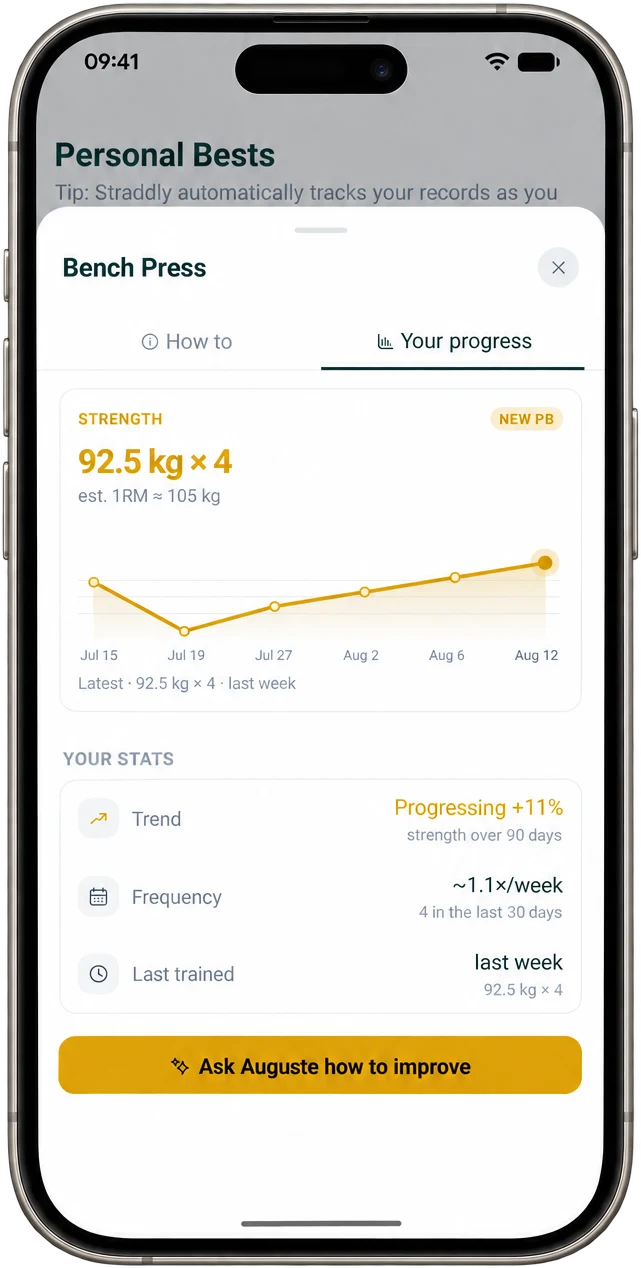 Straddly bench press record screen showing 92.5 kg for four reps, an estimated 1RM near 105 kg and a strength curve
The automatic records view keeps the completed set beside the estimate. Read both. The number helps you spot a change; your notes tell you whether the comparison was fair. A PR badge doesn't mean your next session needs to be heavier.
What to do next session
Choose one lift you already train. Keep its usual place in the workout, warm up normally and use your planned working load with the usual safety setup. Record one representative clean set, its rest period and your estimated RIR. Don't take it to failure just for this exercise.
Calculate with the same formula as last time. Compare only with a similar set, then decide between one more rep, a small load increase or a repeat. If technique broke down, keep the note rather than celebrating the estimate. If pain appears, stop the painful movement and get advice from a physiotherapist or doctor.
The goal for your next workout is a clear target you can execute. The estimated max can stay in the log.
Quick answers
How do I calculate my one-rep max without testing it?
Use a recent clean set and calculate weight × (1 + reps ÷ 30) with Epley. For 80 kg × 5, that gives about 93.3 kg. Record your effort and compare similar sets over time. The result estimates performance; it doesn't guarantee that you can complete that weight for a single today.
Is Epley or Brzycki more accurate?
Neither is universally best for every lifter and exercise. With 80 kg × 5, Epley gives about 93.3 kg and Brzycki gives 90 kg. That disagreement is a reason to treat the number as an estimate. Keep one formula for your training history rather than switching to whichever produces the higher result.
Can I estimate 1RM from a set with reps in reserve?
You can calculate a value, but stopping early means the set wasn't a repetition maximum and the basic formula can underestimate your capacity. Note your RIR and compare sets at similar effort. Don't automatically add RIR to completed reps: that is a separate adjusted model, and your estimate of reserve may be wrong.
Should I add weight whenever my estimated 1RM increases?
Follow your program's rep targets first. In a three-set, five-to-eight-rep example, build toward three clean sets of eight at the intended effort before trying a small increase. A higher estimate from one set doesn't override the rest of the session. Repeat the load if technique, rest or effort changed enough to make comparison unclear.